2026 Regenerative Hair Guidelines: What to Implement Now
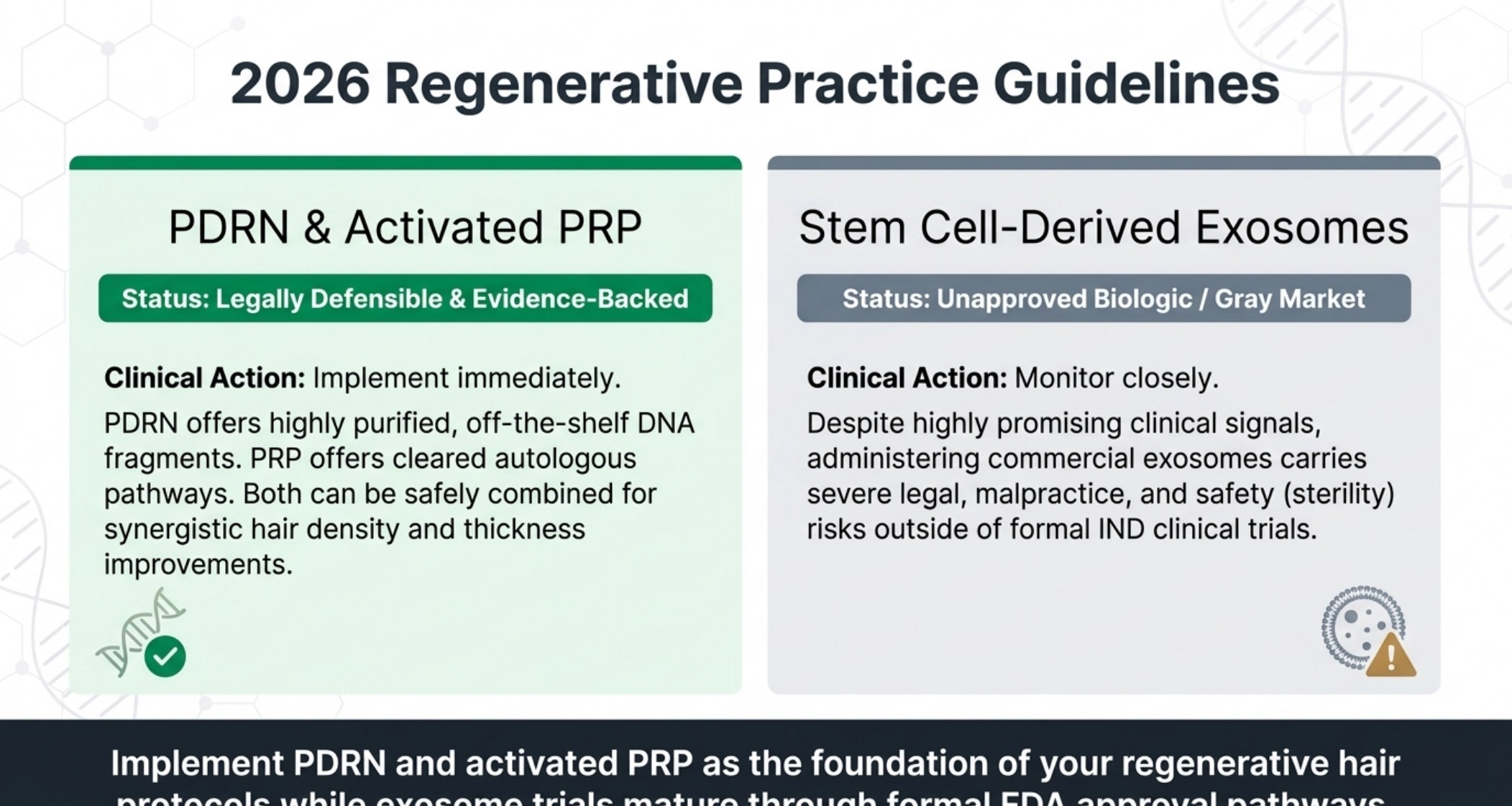
The 2026 guidance in this deck is a two-column instruction, not a menu. PDRN and activated PRP are scored legally defensible and evidence-backed, with the clinical action stated as implement immediately. Stem cell-derived exosomes are scored an unapproved biologic and gray-market category, with the clinical action stated as monitor closely. One line separates a protocol a clinic can run today from a product it cannot lawfully inject, and for a patient in Overland Park that line is the whole decision.
Column One: PDRN and Activated PRP — Implement Immediately
PDRN offers highly purified, off-the-shelf DNA fragments; PRP offers cleared autologous pathways. The deck’s direction is that both can be safely combined for synergistic hair density and thickness improvements, which is why the recommendation is to implement them now rather than wait for the investigational category to mature. The contrast between the two columns is the point of the guideline: one is a decision you can execute, the other is a decision you postpone. The deck frames PDRN as highly purified, off-the-shelf DNA fragments and PRP as a cleared autologous pathway, which is what makes the pairing practical to schedule: standardized inputs, predictable delivery, and no approval gap to explain at the front desk.
The measured basis sits in a 12-week window. PDRN monotherapy, delivered as 12 weekly intra-perifollicular injections, produced +17.9% hair count and +13.5% hair thickness (Lee et al., 2015). Adding microneedling — micro-channel creation combined with topical delivery — produced +20.4% hair count and +53.1% hair thickness (Cho et al., 2016). Patient-reported improvement reached 82.1% (Thanasarnaksorn et al., 2025), and the safety file records over 300,000 global prescriptions with zero serious adverse events in hair loss trials. Standardized chemical manufacture is what makes those numbers reproducible, because it eliminates biological variability.
| Intervention | Protocol | Hair count | Hair thickness |
|---|---|---|---|
| PDRN monotherapy (Lee et al., 2015) | 12 weekly intra-perifollicular injections | +17.9% | +13.5% |
| PDRN + microneedling (Cho et al., 2016) | Micro-channel creation + topical PDRN delivery | +20.4% | +53.1% |
| Patient-reported panel (Thanasarnaksorn et al., 2025) | Combined reporting across protocols | 82.1% improvement rate | Not reported as a percentage |
| Safety record | Standardized chemical manufacture | Over 300,000 global prescriptions | Zero serious adverse events in hair loss trials |
Column Two: Stem Cell-Derived Exosomes — Monitor Closely
The promising signals in this column are real, and the deck does not withhold them: MSC-derived extracellular vesicles show high clinical potential, with +35 hairs/cm² in early trials and a mechanism described as Wnt/β-catenin activation. What keeps the column at monitor-closely is the position around the signal, not the signal itself.
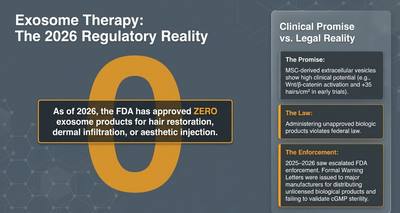
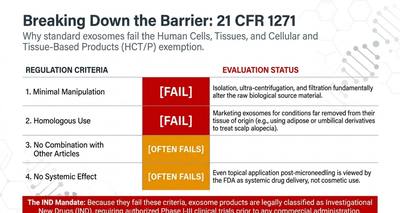
Despite those clinical signals, administering commercial exosomes carries severe legal, malpractice, and safety (sterility) risks outside of formal IND clinical trials. As of 2026 the FDA has approved ZERO exosome products for hair restoration, dermal infiltration, or aesthetic injection, and 2025–2026 saw escalated enforcement with formal Warning Letters to major manufacturers for distributing unlicensed biological products and failing to validate cGMP sterility. A category with no approved product, an IND requirement, and active Warning Letters is not a category to build a protocol on this year. The deck’s direction is to let exosome trials mature through formal FDA approval pathways before the category enters a commercial protocol — monitoring is the action, not delay for its own sake.
| Dimension | PDRN & activated PRP | Stem cell-derived exosomes |
|---|---|---|
| Status | Legally defensible and evidence-backed | Unapproved biologic / gray market |
| Clinical action | Implement immediately | Monitor closely |
| Measured outcomes | +17.9% count and +13.5% thickness; +20.4% and +53.1% with microneedling; 82.1% patient-reported | +35 hairs/cm² in early trials |
| Safety record | Over 300,000 global prescriptions; zero serious adverse events in hair loss trials | Severe legal, malpractice, and sterility risks outside IND trials |
| FDA approval for hair restoration (2026) | Cleared autologous pathway for PRP; highly purified off-the-shelf PDRN | ZERO approved products |
Reading the Mechanisms Before the Marketing
PDRN earns its implement-now position because it acts through two independent mechanisms at once. The first is A2A purinergic receptor activation: salmon-derived DNA (Oncorhynchus mykiss) upregulates VEGF, the vascular endothelial growth factor, to restore microvascular perfusion, while downregulating the pro-inflammatory cytokines TNF-α and IL-6 to resolve chronic perifollicular micro-inflammation. The second is the nucleotide salvage pathway, which bypasses de novo synthesis by feeding purines and pyrimidines directly to the metabolically demanding hair matrix. That accelerates mitosis in the follicle bulb, extends the anagen, or growth, phase, and protects the follicle against apoptosis.
Two mechanisms targeting the environment and the cell separately explain why the combination numbers behave the way they do. When PDRN is paired with microneedling, hair thickness moves +53.1% against +13.5% for monotherapy — a multiple, not a rounding difference — which the deck attributes to improved delivery of a standardized molecule through created micro-channels. The same dual mechanism is why the guideline places PDRN alongside activated PRP rather than against it: one supplies a standardized purified DNA input, the other a cleared autologous one, and the two are treated as combinable.
| Mechanism | What it changes | Where it shows up in the data |
|---|---|---|
| A2A purinergic receptor activation (salmon-derived DNA) | Upregulates VEGF to restore microvascular perfusion; downregulates TNF-α and IL-6 | Environment of the follicle; supports the density endpoint |
| Nucleotide salvage pathway | Feeds purines and pyrimidines to the hair matrix; accelerates mitosis and extends anagen | Cell-level growth phase; supports the thickness endpoint |
| Microneedling delivery | Micro-channel creation combined with topical PDRN | +53.1% thickness versus +13.5% for monotherapy |
Implementing the Guideline in Overland Park
The instruction converts into a sequence. Build the foundation on PDRN and activated PRP, the two columns the 2026 guideline marks as implementable now, and let exosome trials mature through formal FDA approval pathways before treating that category as purchasable. Two honest trade-offs belong in that sequence. First, the implement-now column still requires a real protocol — the evidence is built on 12 weekly intra-perifollicular injections, not a single session, so adherence is part of the outcome. Second, the monitor-closely column will keep generating headlines, and the discipline is to read the approval count, not the press release. A Kansas patient who tracks ZERO approvals and Warning Letters will not be surprised by the category’s next news cycle.
If a clinic in Overland Park recommends a regenerative protocol, ask which column it sits in and why. The answer should name the product’s status, the delivery protocol, and a measured endpoint such as the +17.9% count and +13.5% thickness the PDRN trials reported. Pressure-test the choice with our decision tools, compare the clinical framing in our clinical regrowth breakdown, and see how timelines and cost expectations are set in the cost guide. This page is educational information, not medical advice, and a qualified provider should assess the individual case.
Frequently Asked Questions
What should be implemented now versus monitored in 2026?
Implement PDRN and activated PRP immediately, per the 2026 guideline, and monitor stem cell-derived exosomes closely. The two categories carry opposite clinical actions because their status differs: legally defensible and evidence-backed versus unapproved biologic and gray market.
What measured gains support the PDRN and PRP column?
PDRN monotherapy produced +17.9% hair count and +13.5% hair thickness (Lee et al., 2015); PDRN plus microneedling produced +20.4% count and +53.1% thickness (Cho et al., 2016); patient-reported improvement reached 82.1% (Thanasarnaksorn et al., 2025), with over 300,000 global prescriptions and zero serious adverse events in hair loss trials.
Why are exosomes only monitored if early trials show +35 hairs/cm²?
Because the number and the legal status point different ways. As of 2026 the FDA has approved ZERO exosome products for hair restoration, they are classified as Investigational New Drugs requiring authorised Phase I–III trials, and 2025–2026 brought escalated enforcement with formal Warning Letters for unlicensed biological distribution and failed cGMP sterility validation.
Get matched with hair restoration professionals →
Ready for a Professional Review?
We can connect you with qualified hair restoration professionals who can map your situation to the right treatment.
Get Matched with Hair Restoration Professionals