Exosome Therapy for Hair Loss: Promise vs Regulatory Reality
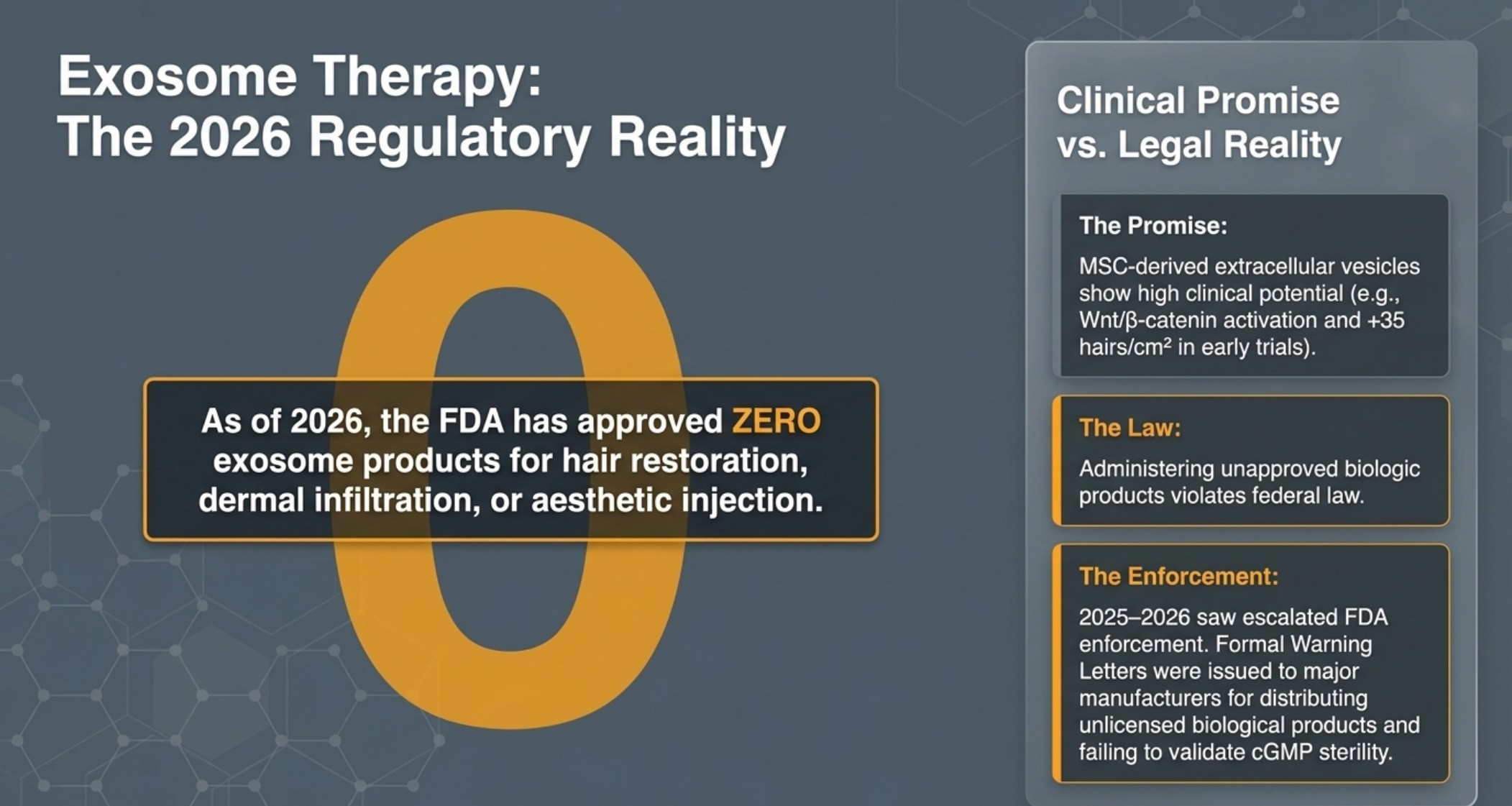
Two numbers decide the exosome question in 2026. Early trials of MSC-derived extracellular vesicles report +35 hairs/cm², a density change attributed to Wnt/β-catenin activation. In the same window, the FDA has approved ZERO exosome products for hair restoration, and administering an unapproved biologic by dermal infiltration or aesthetic injection violates federal law. A plausible mechanism and a lawful product are not the same asset. Anyone in Overland Park weighing an exosome offer is really choosing between those two columns, and only one of them carries an approval number, a sterility record, and a measured endpoint.
The Promise: What +35 Hairs per cm² Does and Does Not Prove
Hairs per square centimetre is a density endpoint, and +35 hairs/cm² is the figure this deck attaches to MSC-derived extracellular vesicles in early trials. The proposed pathway is specific rather than vague: Wnt/β-catenin signalling is the switch that pushes miniaturised follicles back toward the anagen, or growth, phase. A named mechanism attached to a measured density change is stronger evidence than a marketing claim, and it is worth stating plainly that the biology here is credible.
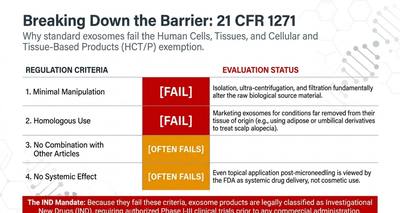
The qualifier carries the weight, though. “Early trials” is the deck’s own phrasing, and early-trial data is not the multi-site randomised evidence that supports a marketed product. Contrast the raw material itself. PDRN, the comparator in the same deck, is described as a standardized, highly purified DNA fragment whose chemical manufacture eliminates biological variability. Exosome preparations are biological isolates whose content shifts with source tissue, culture conditions, and isolation method — isolation, ultra-centrifugation, and filtration fundamentally alter the raw biological source material. That single material difference is what the regulator scores next.
| Metric | What the deck reports | Status for clinical use |
|---|---|---|
| Reported density change (early trials) | +35 hairs/cm² (MSC-derived extracellular vesicles) | Investigational only |
| Proposed mechanism | Wnt/β-catenin activation | Plausible; unvalidated in a marketed product |
| FDA-approved exosome products for hair restoration (2026) | ZERO | No lawful commercial pathway |
| Legal test | Administering an unapproved biologic by dermal infiltration or aesthetic injection violates federal law | Prohibited outside authorised trials |
| Enforcement posture 2025–2026 | Escalated FDA enforcement; formal Warning Letters issued | Distributors and clinics directly exposed |
The Law: “Zero” Is a Count, Not a Waiting Period
As of 2026 the approved count is ZERO — not one exosome product is approved for hair restoration, dermal infiltration, or aesthetic injection. That is a count, not a queue. A pipeline product and an approved product are different things, and a patient cannot buy a pipeline. The deck states the operative legal sentence directly: administering unapproved biologic products violates federal law.
Route of delivery is where many clinics lose the argument. Hair restoration is delivered by injection into the scalp, which is precisely the delivery mode named in the prohibition. A jurisdiction-agnostic reading matters for a Kansas consumer because a clinic cannot cure a federal approval gap with a state business licence, a consent form, or a verbal assurance that the product is “the same thing” the research uses. The approval status sits with the product, not with the marketing. For the underlying science of how regenerative approaches are scored against one another, our efficacy scale ranks the same families on measured outcomes rather than claims.
Enforcement 2025–2026: The Two Failure Modes Behind the Warning Letters
The deck records that 2025–2026 saw escalated FDA enforcement, with formal Warning Letters issued to major manufacturers for two distinct reasons: distributing unlicensed biological products, and failing to validate cGMP sterility. The first is a licensing failure — the product was never authorised for the indication being marketed. The second is the one that should stop a patient at the front desk. Sterility validation is the control that keeps an injectable from carrying contamination into tissue, and a product that fails to validate it has removed the manufacturing safeguard and the regulatory one at the same time.
| Failure mode | What the deck reports | Why it reaches the patient |
|---|---|---|
| Unlicensed biological distribution | Formal Warning Letters to major manufacturers | No approved indication; no lawful commercial pathway |
| cGMP sterility validation failure | Warning Letters for failing to validate cGMP sterility | Sterility is the control protecting an injectable product |
| Combined exposure | Escalated FDA enforcement through 2025–2026 | Legal and malpractice exposure sits on the administering clinic |
Why PDRN Is the Useful Comparator
Numbers only mean something beside other numbers, and the same deck supplies the comparison. PDRN monotherapy, delivered as 12 weekly intra-perifollicular injections, moved hair count +17.9% and hair thickness +13.5% in a 12-week trial (Lee et al., 2015). Combined with microneedling, the same 12-week window produced +20.4% hair count and +53.1% hair thickness (Cho et al., 2016) — the thickness jump being the standout, because microneedling appears to improve delivery of a standardized molecule. Patient-reported improvement reached 82.1% (Thanasarnaksorn et al., 2025).
The safety side of the comparator matters just as much for a decision. Standardized chemical manufacture eliminates biological variability, and the deck records over 300,000 global prescriptions with zero serious adverse events in hair loss trials. Set that against an intervention whose own evidence file is labelled early-stage and whose commercial forms have ZERO approvals and active Warning Letters. The comparison is not that exosomes are useless; it is that one column has traceable outcomes and the other has a hypothesis plus an enforcement record.
| Intervention | Hair count | Hair thickness | Regulatory status 2026 |
|---|---|---|---|
| PDRN monotherapy, 12 weekly injections (Lee et al., 2015) | +17.9% | +13.5% | Legally defensible and evidence-backed |
| PDRN + microneedling (Cho et al., 2016) | +20.4% | +53.1% | Legally defensible and evidence-backed |
| Exosomes (MSC-derived extracellular vesicles) | +35 hairs/cm² in early trials | Not reported as a percentage | ZERO FDA approvals; unapproved biologic |
The Decision Frame for Overland Park
Three questions are answerable before anyone takes a deposit. First: is this specific product FDA-approved for hair restoration? As of 2026 the answer for every commercial exosome product is ZERO, so a “yes” here should come with an approval reference. Second: can the clinic produce cGMP sterility validation for the exact lot it injects? A sterility failure is the failure mode the 2025–2026 Warning Letters named, and it is the one a patient cannot detect afterwards. Third: does the protocol carry a measured 12-week endpoint, the way PDRN does at +17.9% count and +13.5% thickness?
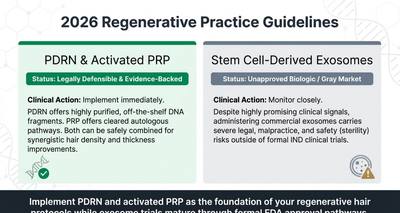
For a Kansas patient, the practical reading is narrow. The 2026 practice guideline in this deck places PDRN and activated PRP as legally defensible and evidence-backed, able to be implemented immediately, and places stem cell-derived exosomes in a monitor-closely column because administering commercial exosomes carries severe legal, malpractice, and sterility risks outside formal IND trials. Compare the two families in our comparison guides, run your own case through the decision tools, and check how cost framing works in the cost guide. This page is educational information, not medical advice, and a qualified provider should assess the individual case.
Frequently Asked Questions
Has the FDA approved any exosome product for hair restoration?
No. As of 2026 the approved count is ZERO — no exosome product is approved for hair restoration, dermal infiltration, or aesthetic injection, and administering an unapproved biologic product by those routes violates federal law.
How much density do exosomes show in the early trials?
Early trials of MSC-derived extracellular vesicles report +35 hairs/cm², attributed to Wnt/β-catenin activation. The deck labels these early trials, which is not the same evidence tier as a randomised, approved product study.
What did the 12-week PDRN trials measure by comparison?
PDRN monotherapy produced +17.9% hair count and +13.5% hair thickness (Lee et al., 2015); PDRN plus microneedling produced +20.4% count and +53.1% thickness (Cho et al., 2016); patient-reported improvement reached 82.1% (Thanasarnaksorn et al., 2025), with over 300,000 global prescriptions and zero serious adverse events in hair loss trials.
Get matched with hair restoration professionals →
Ready for a Professional Review?
We can connect you with qualified hair restoration professionals who can map your situation to the right treatment.
Get Matched with Hair Restoration Professionals