Why Exosomes Fail the HCT/P Exemption: Inside 21 CFR 1271
The FDA does not ban exosomes by name. It applies four criteria under 21 CFR 1271, the rule that governs whether a human cell or tissue product qualifies for the Human Cells, Tissues, and Cellular and Tissue-Based Products (HCT/P) exemption. Standard exosome preparations fail two of the four criteria outright — minimal manipulation and homologous use — and often fail the other two — no combination with other articles and no systemic effect. Fail any one and the product stops being a tissue and becomes a drug. That is the whole dispute, and it decides what can lawfully be injected in an Overland Park clinic this year.
The Four Criteria, Scored
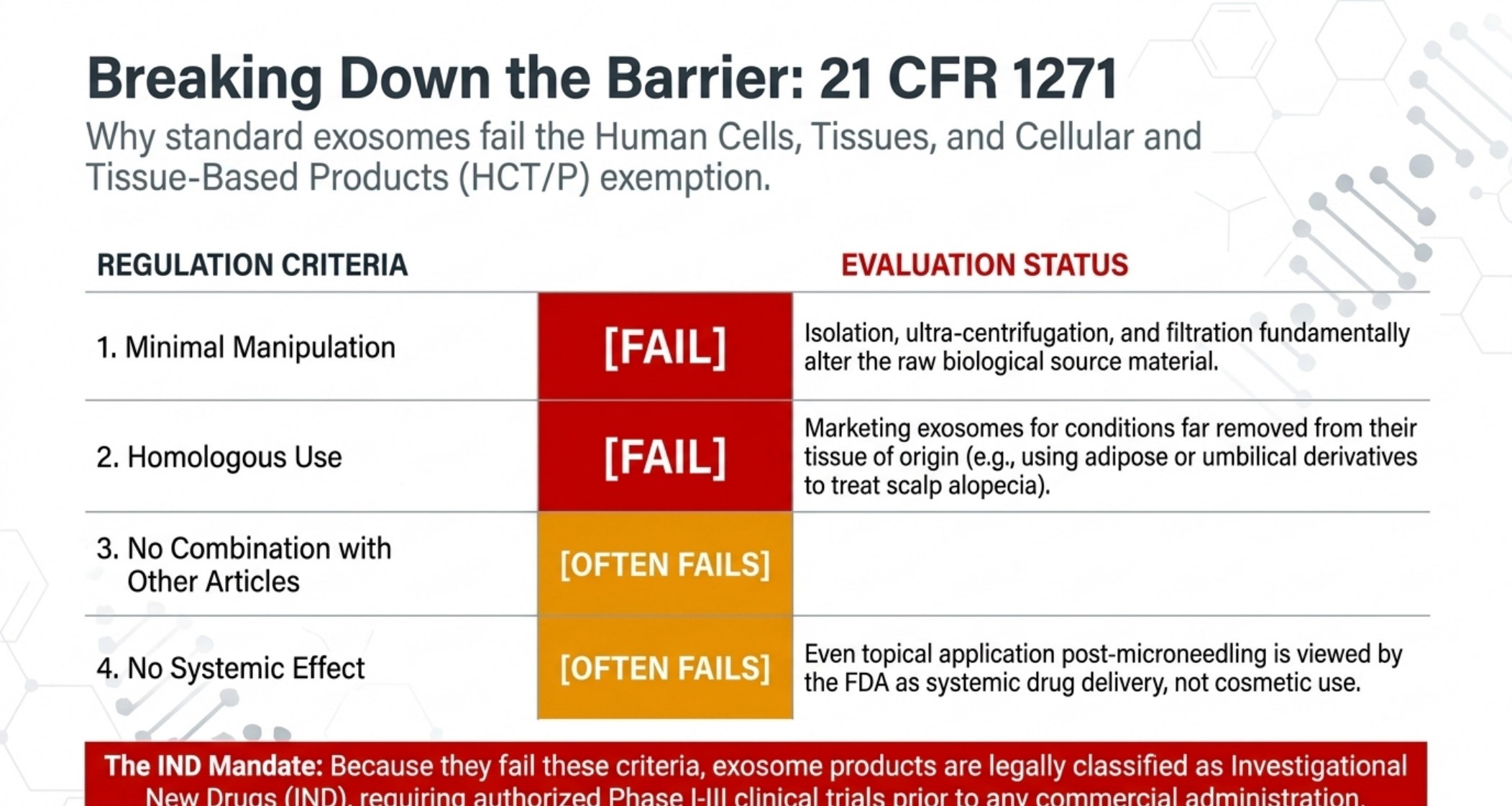
The exemption is narrow by design. A product stays outside the drug pathway only if it is minimally manipulated, used homologously, not combined with other regulated articles, and does not achieve its effect systemically rather than locally. The deck scores exosomes against all four and the pattern is not borderline: two outright failures and two often-failures.
Minimal manipulation fails because isolation, ultra-centrifugation, and filtration fundamentally alter the raw biological source material. The starting tissue is not the finished product; the process that concentrates vesicles is the same process that changes the tissue’s character. Homologous use fails because exosomes are marketed for conditions far removed from their tissue of origin — the deck’s own example is using adipose or umbilical derivatives to treat scalp alopecia. Repair, reconstruction, or replacement of the same basic function is the test; growing scalp hair is not that function for umbilical tissue.
| Regulatory criteria | Evaluation status | Reason recorded in the deck |
|---|---|---|
| 1. Minimal manipulation | FAIL | Isolation, ultra-centrifugation, and filtration fundamentally alter the raw biological source material |
| 2. Homologous use | FAIL | Marketing exosomes for conditions far removed from their tissue of origin, e.g. adipose or umbilical derivatives for scalp alopecia |
| 3. No combination with other articles | OFTEN FAILS | Combining delivery with other regulated articles moves the product outside the exemption |
| 4. No systemic effect | OFTEN FAILS | Topical application post-microneedling is viewed by the FDA as systemic drug delivery, not cosmetic use |
Criteria Three and Four: Why “We Just Microneedle and Apply It” Fails
The third and fourth criteria are where clinic-side arguments usually collapse. Criterion three requires that the product not be combined with other articles, and a regenerative hair protocol is almost always a combination — microneedling or a delivery vehicle layered with the biologic. Criterion four requires no systemic effect, and the deck records the precise reason it commonly fails: even topical application post-microneedling is viewed by the FDA as systemic drug delivery, not cosmetic use. The moment micro-channels are created, the agency stops reading the application as a surface cosmetic and starts reading it as a route into the body.
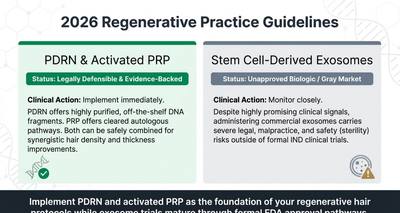
That single reading is why the “we only apply it on top” defence does not hold. It also explains why the same in-office sequence that is lawful for a cleared autologous pathway can be unlawful for a biologic that never cleared the exemption. The delivery technique is not the variable that decides the question; the regulatory status of the thing being delivered is.
| Claim made in the market | Regulatory reading recorded | Criteria affected |
|---|---|---|
| “It is your own biology, so it is exempt” | Isolation and ultra-centrifugation fundamentally alter the raw source material | 1. Minimal manipulation - FAIL |
| “It is a cosmetic, not a drug” | Topical application post-microneedling is deemed systemic drug delivery | 4. No systemic effect - OFTEN FAILS |
| “It is used off-label, which is allowed” | The product itself is unapproved; off-label use still requires an approved product | Whole-product status |
The IND Mandate: What Happens After the Criteria Fail
Because exosome products fail these criteria, the deck states the consequence without hedging: they are legally classified as Investigational New Drugs (IND), requiring authorised Phase I–III clinical trials prior to any commercial administration. This is the hinge of the entire question. IND status does not mean the product is forbidden forever; it means the only lawful route to a patient is enrolment in an authorised trial, with the oversight that a trial carries.
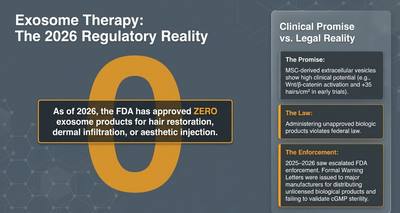
The 2026 landscape reinforces how strict that route is. As of 2026 the FDA has approved ZERO exosome products for hair restoration, dermal infiltration, or aesthetic injection, and 2025–2026 saw escalated enforcement with formal Warning Letters to major manufacturers for distributing unlicensed biological products and failing to validate cGMP sterility. So the practical position is not that approval is close. It is that the HCT/P door is scored shut on two criteria, the IND door is the only lawful one, and that door requires a trial protocol rather than a price list.
| Question | HCT/P exemption route | IND route (where exosomes currently sit) |
|---|---|---|
| Minimal manipulation | Must pass | FAIL recorded for standard exosome isolation |
| Homologous use | Must pass | FAIL recorded for scalp use of adipose or umbilical derivatives |
| Commercial administration | Permitted within the exemption | Not permitted outside an authorised trial |
| Evidence required | Compliance with the exemption criteria | Authorised Phase I–III clinical trials |
Why the Four-Criteria Test Matters Locally
A patient in Overland Park does not need to memorise a regulation to use it. The four criteria convert into four questions, and each has a factual answer rather than a persuasive one. Is the product minimally manipulated, or does its preparation alter the source material? Is it being used for the function of its tissue of origin, or for a distant indication such as scalp alopecia? Is it delivered alone, or combined with microneedling and other articles? Is the intended effect local, or does the delivery method make it systemic? A single failure on minimal manipulation or homologous use is enough to move the product into IND territory, and IND territory means trials, not treatments.
The broader framing for a Kansas consumer is that regulation here is a gate, not a verdict on the biology. The how it works walkthrough explains how these products move from laboratory to lawful clinical use, and the FAQ covers the questions patients ask first, including what to request from a clinic. If a clinic cannot state which pathway a product sits in, that silence is the answer. This page is educational information, not medical advice, and a qualified provider should assess the individual case.
Frequently Asked Questions
Which 21 CFR 1271 criteria do exosomes fail?
Two outright and two often. Minimal manipulation is scored FAIL because isolation, ultra-centrifugation, and filtration fundamentally alter the raw biological source material, and homologous use is scored FAIL because products are marketed for conditions far removed from their tissue of origin, such as adipose or umbilical derivatives for scalp alopecia. Combination with other articles and systemic effect are scored OFTEN FAILS, since topical application post-microneedling is viewed as systemic drug delivery.
What does IND classification mean for a patient?
Because the products fail the criteria, they are legally classified as Investigational New Drugs requiring authorised Phase I–III clinical trials prior to any commercial administration. In practice that means treatment is available only inside an authorised trial, not as a purchasable service.
How many exosome products are FDA-approved for hair restoration as of 2026?
ZERO. No exosome product is approved for hair restoration, dermal infiltration, or aesthetic injection, and 2025–2026 saw escalated enforcement with formal Warning Letters to major manufacturers for unlicensed biological distribution and failed cGMP sterility validation.
Get matched with hair restoration professionals →
Ready for a Professional Review?
We can connect you with qualified hair restoration professionals who can map your situation to the right treatment.
Get Matched with Hair Restoration Professionals